Showing posts with label social justice. Show all posts

Saturday, August 7, 2021

Equality and Wealth--What Moses Teaches Us

I delivered this as the d'var Torah (sermon) at Temple Beth Israel in Waltham, MA on August 7, 2021.


All of us face moments when we very consciously are at the intersection of before and after, of past and future. It may be as we plan out a career change. As we leap into parenthood. As we leave a home where we’ve built a life, to start a new stage in our journey. Or as we end a period of drifting and begin to build a settled life.

That last type of transition is the intersection of past and future at which the Israelites find themselves before crossing the Jordan, and in Parasha Re’eh Moses helps them to establish clear distinctions between the two. At the same time, he draws some threads between them, so we have forever remained bound up with yet separate from our time as wanderers in the desert.

If the Israelites don’t know they are at this at this crossroads—or more accurately cross-river—Moses is going to make sure they figure it out.

As soon as they enter the land, he tells them, they must reaffirm the covenant in a ceremony that will be described when we get to Parasha Ki Tavo in a few weeks. This points to just how transformative it will be to cross the Jordan, that it requires a sort of reboot of our covenant with God.

Then they must destroy any site of worship or sacrifice that will not be the central one. This seems like it would be connected to ensuring there is no vestige of Paganism. But that doesn’t seem to be to be the whole story. Because it’s not only about destroying the prior sites. They also cannot establish any such site anew. There is only one, and it is fixed. Wandering in the desert, the place of God’s presence was, like the entire community, a roving site. But now connection with God, where God inhabits and can be worshipped, is rooted firmly in place. This is so critical, that the people are given permission to slaughter and eat meat where they live, so long as it is not a sacrificial slaughter, so the urge for meat can be satisfied without worrying about creating sacrificial sites that are conveniently close to home.  With the settlement of the people comes the settlement of God in their midst, and by laying it out Moses clearly signals a new phase, the passage from past to future.

I find especially interesting the advice Moses gives on discerning true prophecy from false. Those giving “a sign or a portent” should not be heeded. Instead we must listen to the message –“God’s commandments alone”—and know the difference. We must not be distracted from the substance of God’s word by what appear as wonders. Yet God provided Moses with the ability to perform signs and wonders in order to be believed, in the desert we know God’s presence through visual wonders—a pilar of cloud and fire. So again, the Israelites understand that their world is about to change, and they must change with it. They must live by the firm and fast words of the commandments and no longer be distracted by the types of bells and whistles that until now pulled their attention where it needed to go—but now would only serve to lead them astray.

So what are they learning about this imminent future?

It’s a different life—so different, the covenant needs affirmation there. The change will be so jarring, that they’ll need this ceremonial reminder, this reassertion.

It’s a fixed kind of life—so fixed, that even sacrificial worship, even God’s inhabitance, has one and only one place. No urge to connect with God, wherever one may be,  can warrant sacrifice elsewhere.

It’s a serious kind of life, one that requires substantive discernment to overcome the lure and distraction of visual enticements.

As Moses says, it’s a disciplined life, where “[y]ou shall not act at all as we now act here, every man as he pleases.” In return for the land and the security it affords, we have to change. And with that security, we have the wherewithal to change. The insecurities and physical challenges of wandering without a stable home or homeland, with only a memory of slavery behind us, has not left a lot of time, energy or focus for the level of discipline and clarity that Moses is describing.

There’s another big change, which also derives from entering a more secure and stable life. As Rabbi Shai Held puts it in The Heart of Torah, this is a point of “transform[ing] Israel into a community of mutual care and concern.” In this parashah we are told to tithe to sustain the Levites, the strangers, the orphans and the widows; to forgive debts; to “open your hand” to the needy so they will have what they require; to free slaves and when doing so to give them the sustaining assets they need to forge an independent life.

It’s interesting that just before telling the Israelites to care for the needy, Moses says “There shall be no needy among you.” This may seem like a contradiction.

But I believe that it is at the heart of these commandments to care for those in need. It’s a statement of our fundamental equality. Some may need financial help, but we are equally endowed as members of society, and what we do to redistribute wealth more equitably is simply in the service of that basic equality. As Rabbi Held puts it, “The Torah exhorts Israel to remember that socioeconomic status tells us nothing at all about the real worth of people.” Quoting biblical scholar Walter Brueggemann, he adds “…economic realities are not definitional; rather what is definitional is a common memory of the Exodus; a common blessing in the land; and a common allegiance to the God of Exodus and the land.”

We cannot simply avoid oppressing. We must actively seek to help, taking part with intention in equalizing the stability and security that is endowed to us as we cross the Jordan. If we don’t help the poor, in fact, they should cry out and God will find our lack of generosity beyond toleration—we will be punished. Economic viability is in the service of community viability, and that healthy social fabric is contingent on the economic health of each and every individual.

After Moses lays down these and many other rules for the land and life to come, he moves on the pilgrimage festivals. The Passover sacrifice followed by seven days eating unleavened bread; seven weeks later, to mark the end of the harvest, the Feast of Weeks; and then once the produce is processed, the Feast of Booths.

We have just been lectured on the strikingly different life we must lead in this future, and now we are told to observe festivals that will interweave that future with the past we are leaving.

Passover connects us to our departure from Egypt as we struck out to be desert wanderers. The harvest pull us forward again to a life rooted in a fixed agricultural society. And then Sukkot returns us to our uprooted existence in impermanent structures.

Why should the parashah end this way?

We cannot advance our future without knowing where we are from. Remember Brueggemann’s observation that “what is definitional is a common memory of the Exodus; a common blessing in the land; and a common allegiance to the God of Exodus and the land.”

There is no severing those connections. As sharply different as a future stage in life may be, we build it on and in reaction to the experiences of our past. When Moses tells us to free our slaves, he reminds us that we were slaves in Egypt. By nestling the celebration of the harvest—the quintessential bounty of wealth and security in a settled land—between the experiences of the exodus and our nomadic wandering, we remember where we came from and the hardships we endured on the way to crossing the Jordan. And in remembering that, perhaps we can remember to do our part in equalizing our wealth and security, and thus strengthening the social fabric for all.


Saturday, August 5, 2017

Legacy

I delivered this d'var Torah ("word of Torah," or sermon) at Temple Beth Israel in Waltham, MA on Saturday, August 5, 2017.

*** 

My father, Bernard Wolfman
Next Shabbat will be my father’s yahrzeit, and each year I like to honor his memory by delivering a d’var Torah around this time.

Va-etḥannan seems like an appropriate parashah for recalling my father. I won’t suggest that he was a modern-day Moses, but my father was called teacher by many. His role as an educator—professionally and as a parent—was a tremendous source of satisfaction for him and a great benefit to all of us on the receiving end. Just as Moses is facing the end of his life by recounting to the Israelites the substance and meaning of the exceptional journey they have lived together and its implications for their future, as my father neared the end of his life he reflected on our family. There was one remarkable night when I sat by him and he narrated to me the emotional histories of each of his children, clarifying for me how closely he had paid attention throughout our lives and bequeathing to me his insights and the opportunity to build from them even in his absence.

One legacy my father left with all of us was his uncompromising commitment to social justice. This quite simply was woven into our family story—not only in what he told us, but in what we saw every day in how he lived and worked. Social justice also runs through the fabric of Moses’s narrative in Va-etḥannan.

From the opening, Moses essentially is saying “I won’t be there with you, much as I want and pleaded. So hear me because my words, and all we have seen together, are all I can give you; and what you take from them are what you can take with you.”

After recounting that he had not been worthy to live to enter the land, he nonetheless is prepared to provide the instructions that—if followed—will ensure the Israelites are worthy to do so. His personal story is instructive. As Moshe Rabbeinu, he teaches even through his frailties by demonstrating what not to do. And then he declares that this responsibility to serve as a model for others extends to all of Israel. “Observe them faithfully,” he says of the laws, “for that will be proof of your wisdom and discernment to other peoples.” (ch 4:vs 6) 

This brings to mind the Aleinu, which says first that we bow down and then—from our example—that all the world’s inhabitants will know to do so.

Just after this, (ch 4:vs8), the theme of social justice is emerging.  “What great nation has laws and rules as perfect as all this Teaching that I set before you this day?” Moses asks. But the notes in Etz Hayyim point out that the Hebrew says tzadekim, which better translates as “just” than “perfect.” So the message really is that the laws and teaching are uniquely just.

Interwoven with this is a theme of seeing, hearing and remembering. There is great emphasis on truly seeing and hearing, so one can learn, so these just laws are seared into memory and guide how one functions in the world—and into future generations. “Do not forget the things that you saw with your own eyes…so that they do not fade from your mind,” he exhorts, adding, “And make them known to your children and to your children’s children.” He recalls that God said to him at Mount Horeb, “Gather the people to Me that I may let them hear My words, in order that they may learn…and may so teach their children.”

Moses goes on to exquisitely evoke revelation as a mystically visual and concretely hearing experience. “The mountain was ablaze with flames.” “[Y]ou heard the sound of words but perceived no shape—nothing but a voice.”

Continuing with the themes of seeing and hearing, the injunction against sculptured images of God characterizes idols as precisely the opposite of God’s appearance at Mount Horeb—they are concrete to see, and nothing to hear.  And they themselves “cannot see or hear or eat or smell.” (ch.4: vs.35-37) He goes on, “It has clearly been demonstrated to you that the Lord alone is God; there is none beside him. From the heavens He let you hear His voice to discipline you; on earth he let you see His great fire; and from amidst that fire you heard His words. And because he loved your fathers, He chose their heirs after them….” Again: hearing, seeing, and passing to future generations.

After this extraordinary justification for following the laws, and before giving them, we have a seemingly incongruous moment of social justice: (ch.4: vs.41-43) “Then Moses set aside three cities on the east side of the Jordan to which a manslayer could escape, one who unwittingly slew a fellow man without having been hostile to him in the past; he could flee to one of these cities and live.” This comes from the narrative voice, not Moses’s, and the reason for its appearance here is a little unclear. Maybe it’s a bit of unfinished business, and Moses worries that – once he delivers the laws—it will be time for him to die. So perhaps he believes that this is his last chance to create this protection for those who may accidentally commit manslaughter in the chaos that could ensue as they enter and battle for the land.

Whatever the reason for it to appear here, I find it compelling that the theme of social justice enters so strongly, just as we are about to enter the Decalogue. The ten commandments, as we know, move from laws about our relationship with God to those about our relationship with each other. We might therefore expect that social justice would enter into those later commandments. But in fact they start earlier.

The laws that address our relationship with God are punctuated with exhortations for social justice among people. “You shall not swear falsely by the name of the Lord your God; for the Lord will not clear one who swears falsely by His name.”—this may dictate how we invoke God, but it also forbids us from sworn false accusations against each other. And the requirement to observe Shabbat also addresses treatment of slaves, equality between men and women, and fair treatment of animals. Embedded in our relationship with God is an expectation of social justice.

Once we exit the Decalogue, the focus on hearing and seeing returns, again with the visual on the mystical and even overwhelmingly frightening end of the spectrum, with “the mountain…ablaze with fire,” and the aural at the firmly human end, with Moses as the intermediary through which the Israelites will hear “the laws and the rules.” Hearing, as a theme, reaches its apex with the words of the shema (ch6:vs4), succinctly charting the path from hearing to conviction to behavior and to teaching future generations. “Shema Yisrael Adonai elohenu, Adonau ehad…” “Hear, O Israel! Adonai is our God, Adonai alone. You shall love Adonai with all our heart and with all your soul and with all your might. Take to heart these instructions with which I charge you this day. Impress them upon your children.”

Now, it gets complicated.

As we enter and take possession of the land and its many assets, we must do so with the humility of recognizing that we developed none of them. Such humility can be a key element of effectively pursuing social justice. We must “take heed that [we] do not forget the Lord who freed [us] from the land of Egypt, the house of bondage,” a reminder that often is coupled with specific social justice obligations, such as our responsibilities to strangers. And we are to “do what is right and good in the sight of the Lord,” another line that might lead us to a mindset of righteousness.

But instead, we are told to destroy the nations in the land without mercy, and that we must do so because we are God’s “treasured people”—chosen, despite being a small band, on the strength of an oath God made to our ancestors.

As I said, it’s complicated.

But today I’m taking from this parashah the elements that foster clarity. Truly hearing in a manner that brings understanding. The majesty of what we see in the world and how it manifests our experience of God, or spirituality, or mysticism—however we define it. The imperative of social justice for living in community. And the urgency of teaching the next generation. Moses shows us all, and my father certainly demonstrated to me, that these are brought into particularly sharp focus when we close in on the end of life.

I wish for all of us—wherever we are in the course of our lives— that we hear, that we see, that we learn, that we teach, that we foster social justice in all we do, and that we help ensure the same for the generations that follow us.

Shabbat Shalom.


Saturday, August 22, 2015

Justice, Humanity and Faith

I delivered this as the d'var Torah (sermon, or "words of Torah") at Temple Beth Israel in Waltham, MA on Saturday, August 22, 2015.  The Torah portion was Shoftim.

“Congress passed the Affordable Care Act to improve health insurance markets, not to destroy them. If at all possible, we must interpret the Act in a way that is consistent with the former, and avoids the latter.”

-Chief Justice John G. Roberts, Jr., June 25, 2015, majority opinion in King v. Burwell, regarding health care subsidies
“Much progress remains to be made in our nation’s continuing struggle against racial isolation. The court acknowledges the Fair Housing Act’s continuing role in moving the nation toward a more integrated society.”

-Justice Anthony M. Kennedy, June 25, 2015, majority opinion in Texas Department of Housing and Community Affairs v. Inclusive Communities Project, regarding housing discrimination

“No union is more profound than marriage, for it embodies the highest ideals of love, fidelity, devotion, sacrifice, and family. In forming a marital union, two people become something greater than once they were. As some of the petitioners in these cases demonstrate, marriage embodies a love that may endure even past death. It would misunderstand these men and women to say they disrespect the idea of marriage. Their plea is that they do respect it, respect it so deeply that they seek to find its fulfillment for themselves. Their hope is not to be condemned to live in loneliness, excluded from one of civilization’s oldest institutions. They ask for equal dignity in the eyes of the law. The Constitution grants them that right.

-Justice Anthony M. Kennedy, June 26, 2015, majority opinion in Obergefell v. Hodges, regarding marriage equality

 “This case concerns an endeavor by Arizona voters to address the problem of partisan gerrymandering — the drawing of legislative district lines to subordinate adherents of one political party and entrench a rival party in power…. The animating principle of our Constitution is that the people themselves are the originating source of all the powers of government.”

-Justice Ruth Bader Ginsberg, June 29, 2015, majority opinion in Arizona State Legislature v. Arizona Independent Redistricting Commission, regarding partisan redistricting

In the course of four days in June, the Supreme Court of the United States handed down in rapid succession these rulings for equity—in health access, in housing access, in marriage access, in political access. 

Do you know the feeling, when seeing something of great beauty, that you are at once filled up by it, yet oddly hollowed as it leaves room for little else? That is the best I can describe how I felt for at least a week after these rulings—physiologically altered by the knowledge of them, filled by them.  The intensity has receded, but the sharp reminder of my awe at the power of justice remains acute.

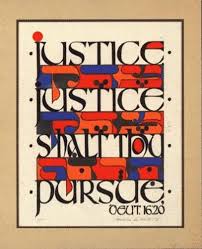
Two weeks ago, my mother, Toni Wolfman, asked me about the theme of my upcoming d’var Torah.  I remarked that it would be the week of parasha Shoftim, with its extraordinary line, “Tzedek tzedek tirdof” – “Justice, justice, shall you pursue,” offering the opportunity to bring the recent Supreme Court decisions into my comments.  Toni told me that she had seen posters featuring that quote on the walls in Justice Ginsberg’ s chambers.  The two of them, along with—when they were alive—my father Bernard Wolfman and Justice Ginsberg’s husband Marty Ginsberg, have shared a friendship for many years.

Toni also directed me to a speech that Justice Ginsberg delivered in 2002 upon receiving the Albert D. Chernin Award from the Jewish Council for Public Affairs.  Justice Ginsberg said:
On walls of my chambers, I have posted in two places the command from Deuteronomy—“Zedek, Zedek," "Justice, Justice shalt thou pursue." Those words are an ever present reminder of what judges must do "that they may thrive." There is an age old connection between social justice and Jewish tradition. Supreme Court Justice Arthur Goldberg… once said: "My concern for justice, for peace, for enlightenment . . . stems from my heritage."
In saying “that they may thrive,” Justice Ginsberg paraphrased the next few words of the biblical sentence, which in full states “Justice, justice shall you pursue that you may thrive and occupy the land that Adonai your God is giving you.”

At first reading, Shoftim might suggest rigidity in the legal system—twice stating that there may be no deviation “either to the right or to the left,” describing first how the people must adhere to the law and then how a king must do so. Yet the parasha firmly endorses the framework of an interpretive and evolutionary system of justice, one dependent upon human observation, intellect and judgement, and responsive to changing times.  Regarding “matters of dispute in your courts,” criminal or civil, the parties must present their cases to “the magistrate in charge at the time” and, upon a verdict, “act in accordance with the instruction given and the ruling handed down.”  This establishes the authority of judges to weigh matters and determine what is just in current society.

Similarly, this parasha makes room for governance by and for the people:  “…you shall be free to set a king over yourself…,” it states.  But there are parameters that God sets forth for any such king, constraints that seem intended to ensure a combination of objectivity and relevance. The king must be a kinsman, and thus govern from a native knowledge of, and perhaps loyalty to, his people.  The king cannot have such wealth that he risks condescension to those he leads, as the Torah states that “he shall not keep many horses…. And he shall not have many wives…nor shall he amass silver and gold to excess.”  And “he will not act haughtily toward his fellows.” So not only must one who governs be by and for the people; he must truly be of the people.

Recently, I heard a re-cast of a 2014 CBS interview with John Mellencamp.  A couple of years ago, at age 62, he learned that as a newborn he’d had ground-breaking, life-saving, 18-hour surgery for spina-bifida.  He was one of three infants receiving this new surgery in 1951 and the only one to live to adulthood.  One died during the operation, the other at age 14.  So Mellencamp got together with the surgeon who had saved his life, 97-year-old Dr. Robert Heimburger.  This is how Mellencamp recalled that meeting in his interview: "Basically we talked about faith, 'cause I have very little faith in anything." Mellencamp said that the doctor "just kept grabbing my hand and saying 'John, you need to have faith.'" And so now he says he’s "trying to find faith in something."

I’ve also always found faith—belief in something amorphous--to be one heck of a challenge.  And while sometimes I can grab onto the feeling of God, the fact or lack of faith in such a being can seem irrelevant, having little to do with how I act in this world. But as I heard Mellencamp recall his conversation with Dr. Heimburger it coalesced for me with my study of Shoftim and my reaction to this summer’s Court decisions.  I realized that the promise of justice gives me faith in humanity.  I understand that not every Court ruling will sit well with me; and some—to my mind—simply defy any understanding I have of justice.  Yet the promise is always there.  I’m acutely aware that in this same summer we have witnessed people gunned down, stabbed, and burned, and churches destroyed—in some cases in the name of patriotism and God—tempting us to fall into despondency. Yet our human-built and human-administered system of justice—which, transcending mere promise, has shown that it can burst forth with rulings that in four days fundamentally shift our society to one demanding greater equity and greater access—instead moves me to have faith in humanity. That may sound trite or simplistic, but I’m speaking of the power and desire that can live in and emerge from us—mere people—to shift the world in better directions.

Our text itself endorses and even mandates destruction and dispossession in the name of God and nationalism.  Yet it holds forth the promise of a system of justice and governance with the flexibility to mature over time and thus profoundly change civilization.  And it places faith in judges and leaders—people—to make that happen.  I share that faith in humanity.

But that’s not enough.  Perhaps this is what forms that basis of my difficulties with faith—ambivalence and even skepticism regarding faith.  It’s too easy to stop there, because we believe that something, someone, some power will take care of things.  Even the power and promise of justice, and even the fact of justice done well, does not take care of things.  We do.

While the knowledge of our Supreme Court’s rulings on equality may have filled me, their impact hits a ceiling, and my faith in humanity means little, unless they catalyze us to act.  The rulings give us a framework and an opportunity.  Let’s seize it.

A dozen years ago, when my son had some extra time, I decided it was a great opportunity to expose him to a variety of volunteer activities.  He responded with frustration at the meager impact of a few hours here and there in disjointed activities for small outreach organizations.  He said that he wanted to be involved—whether through activity or donations—only in large systemic change, so each contribution would by virtue of expanded infrastructure and efficient leverage of resource achieve greater influence.  While I still find value in individual contribution, in building upon small and even singular activities, and in exposing children to participation through exposure through manageable activities—I’ll concede that it wasn’t for Isaac.  What did appeal to him was joining a group of youth who formed a grant allocation board within Jewish Family & Children’s Services in Philadelphia.  Each researched, visited, reported on and issued recommendations for organizations to fund, and the group then voted for one to receive a significant grant—to which the children themselves in part contributed.  And, the fact is, Isaac was correct—when we function collectively, when we build infrastructure, when we achieve scale, we can extend the impact of each individual actor and each dollar.

I share this to illustrate why I said, a moment ago, that the rulings offer a framework and stimulus for us to act. Not me.  Not you.  Not him. Not her.  Us.  So I want to know how we as a community will respond at this catalyzing moment for impacting issues of equality.  Not how one of us addresses access to food for poor people, or how another of us addresses access to education and employment for people with mental illness.  These are important efforts that should continue.
But as a community and as an organization, how will we organize to singularly and amply commit our collective time, funds and infrastructure to  turning the promise of one of the rulings--for equity in health access, in housing access, in marriage access, or in political access—into  substantive effect?

Two days ago we marked, on the Gregorian calendar, the fourth anniversary of my father’s death.  He was a person for whom the pursuit of justice, and the practical societal implementation of its promise, informed just about everything. Even my name reflects that.  I’ve spoken today to honor my father, to celebrate the impact of a system built on justice, and to urge us to do justice by going beyond faith—to organize as a faith community, and as an institution—in a structured, ongoing, strategic, all-hands-on-deck manner to influence equity at scale. 

Saturday, July 17, 2010

The ethical will: is living it enough?

[Note: This is a re-post of the May 13, 2010 entry on my former Open Forum blog.]


In the chapter entitled "Justice" in my book Creative License, I talk about ethical wills and link the concept of justice - and the way we uphold it in our lives - to the leaving of an ethical will.  At the outset, I talk of my sadness that my mother left me no written or recorded words.  And though I fully acknowledge that it is the life she lived, exemplary of upholding, fighting for and modeling social justice, that was her ethical will and my cherished inheritance, in the end I have written these sermons and published this book ... perhaps as the ethical will for my children, as I do want the words on paper so they may never repeat my struggle of questioning why nothing was left for them.  A life in pursuit of justice is inextricably linked, for me, to the ethical will.  Yet as a person of words, I seem to find that the action and the example do not suffice.  I'd love to hear from others, here and/or at the blog on my book's site:  What fundamental values and struggles do you find bound up in the notion of the ethical imperatives we wish to imprint on our ethical heirs?  And if we live it, is that enough, or must we leave it in a more indelible form?